If you have any questions, please feel free to contact us.| Email Us: info@dcheatpress.com


Views: 222 Author: Amanda Publish Time: 2026-01-06 Origin: Site


Content Menu
● What Is a Clamshell Heat Press?
● What Is a Swing Away Heat Press?
>> Main Performance Differences
● Advantages of a Clamshell Heat Press
● Advantages of a Swing Away Heat Press
● Disadvantages and Limitations
● Which Heat Press Fits Your Business?
● Practical Application Scenarios
● Step‑by‑Step Checklist for Choosing Your Heat Press
● How a Professional Manufacturer Can Support Both Needs
● Choose Your Ideal Press and Plan Your Upgrade Path
● FAQs About Clamshell and Swing Away Heat Presses
>> 1. Is a clamshell or swing away press more suitable for beginners?
>> 2. Which heat press type is safer for daily operation?
>> 3. Can a clamshell heat press handle thick substrates?
>> 4. Does a swing away heat press always require a lot more space?
>> 5. Should a professional print shop invest in both clamshell and swing away presses?
Choosing between a clamshell heat press and a swing away heat press directly affects your production efficiency, print quality, operator safety, and long‑term profitability. This guide compares both designs in depth and helps you align your choice with your space, substrates, and business goals.

A clamshell heat press features an upper platen that opens and closes on a hinge at an angle, similar to a clam's shell. This vertical, angled movement makes the design compact and popular for apparel decorators working in tight spaces.
A clamshell is typically used for:
- T‑shirts, hoodies, and flat garments
- Thin fabric items like tote bags and pillow covers
- Lightweight flat substrates such as flat photo panels and soft accessories
A swing away heat press lifts the upper platen straight up and then swings it completely away from the lower platen. This creates a fully open, heat‑free workspace over the bottom platen.
Because the platen moves vertically before contacting the substrate, pressure is applied more evenly across thicker and rigid items. A swing away press is ideal for:
- Hard substrates like tiles, plaques, and MDF boards
- Thicker garments or layered materials
- Detailed or premium applications that demand very uniform pressure
The table below summarizes how each press type performs on practical buying factors.
Factor | Clamshell Heat Press | Swing Away Heat Press |
Space requirement | Small footprint; suitable for tight countertops and home studios. | Requires more side clearance to swing the platen away from the work area. |
Pressure on thick items | Less consistent on very thick or uneven substrates. | Vertical application gives very even pressure on thick or rigid substrates. |
Safety and burn risk | Hands stay close to the hot platen when loading and unloading. | Hot platen moves away, creating a cooler, safer workspace. |
Production speed | Fast open/close cycle; great for quick T-shirt runs. | Slightly slower handling but excellent for precise, careful placement. |
Learning curve | Straightforward for basic apparel jobs. | Requires a bit more familiarity with swing movement and positioning. |
Best use cases | High-volume garments and flat soft goods in limited spaces. | Thicker items, rigid blanks, and premium, high-detail work. |
A clamshell press is often the first machine chosen by startups and small shops because it is simple, compact, and efficient.
Key advantages include:
- Space efficiency: The vertical opening saves depth, making it easier to fit on standard work tables.
- Faster cycling: The open‑and‑close motion supports high‑volume T‑shirt and hoodie production.
- Lower initial cost: Many entry‑level and mid‑range models are clamshell designs, which helps reduce startup investment.
- Fewer moving axes: The simple hinge structure can result in straightforward operation and maintenance.
For businesses focusing mainly on flat apparel and soft goods, a clamshell heat press can deliver reliable, repeatable results with minimal operator training.
A swing away press is designed for users who value versatility, safety, and uniform pressure on challenging substrates.
Major benefits include:
- Even pressure: The upper platen travels straight down, distributing pressure more consistently across thick or uneven materials.
- Safer workspace: The hot platen swings completely away from the lower platen, giving operators more room and reducing accidental contact.
- Better for rigid blanks: Tiles, plaques, coasters, cutting boards, and similar products benefit from the vertical pressure pattern.
- Easier layout: With the platen out of the way, it is simpler to position transfers, tape, and alignment tools precisely on the substrate.
If your product line includes many hard or thick items, a swing away press will usually provide more consistent quality and fewer misprints.
Both press types have inherent limitations, and understanding them helps you avoid expensive mismatches.
- Uneven pressure risk on thick items: The angled closure can create slightly higher pressure near the hinge and lower pressure at the front.
- Higher burn risk: Operators work under the hot platen, which increases the chance of accidental contact during busy production.
- Limited clearance: Bulky garments or stacked layers can be harder to position accurately between the platens.
- Larger footprint: The swinging motion requires space on at least one side of the press.
- Heavier structure: Swing away presses tend to be heavier and less portable, which matters for event‑based printing.
- Slightly slower rhythm: The lift and swing movement can add a small amount of time to each cycle compared to a quick clamshell closure.
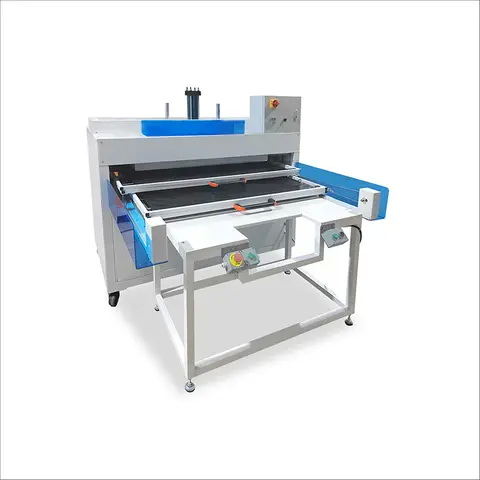
Instead of asking which design is universally better, focus on which one fits your current and future business model.
You may lean toward a clamshell if:
- Most of your work involves T‑shirts, sweatshirts, and other flat garments.
- You operate in a small studio or shop where every centimeter of space matters.
- You prioritize speed and simple operation for short‑run or on‑demand apparel.
You may lean toward a swing away if:
- You frequently press plaques, tiles, thick garments, or layered substrates.
- Safety and ergonomic comfort are critical for your team.
- You want premium consistency for high‑value personalized products.
Some professional print shops ultimately operate both types: clamshell presses for fast garment runs and swing away presses for thicker or specialty items.
Examining typical scenarios makes it easier to map each press type to real workflows.
- Apparel‑only startup: A small brand selling custom T‑shirts online can build a lean, efficient production line around a clamshell, benefiting from a small footprint and quick cycle times.
- Gift and décor studio: A shop specializing in photo panels, tiles, awards, and plaques gains more value from a swing away machine that handles rigid substrates with consistent pressure.
- Hybrid print shop: A business offering both apparel and sublimation gifts may use a clamshell for garments while reserving a swing away press for thick, premium items.
Thinking through your top‑selling products and long‑term direction will clarify which configuration delivers the strongest return on investment.
Use the following checklist to guide your buying decision and avoid overlooking key factors.
1. Identify your core products
- List your top products by volume and profit (shirts, hoodies, tiles, plaques, etc.).
- Decide which press type aligns best with those specific substrates.
2. Measure your production space
- Record the depth and width of available tables and surrounding clearance.
- Confirm you have enough side space if you plan on a swing away model.
3. Estimate your production volume
- Determine whether your business focuses on short‑run personalization or continuous, high‑volume output.
- Match a fast‑cycling clamshell to rapid garment work, or a swing away to careful, high‑value jobs.
4. Assess operator safety and comfort needs
- Consider how many hours per day the press will be used and by whom.
- Evaluate whether an open, heat‑free workspace is essential for your team.
5. Align the purchase with your growth plan
- Choose the press that best supports your current core products.
- Plan for a future upgrade path where you may add the other press type as your catalog expands.
Working with a manufacturer that focuses on research, development, production, sales, and service enables you to match equipment to your exact workflows.
Such a partner can:
- Provide both clamshell and swing away heat presses tailored to different substrate categories.
- Offer welding and embossing solutions that integrate into the same production ecosystem.
- Support global customers with training, after‑sales service, and configuration advice as product lines evolve.
When your supplier understands the full range of printing applications, it becomes easier to standardize on reliable, compatible equipment across garment, hard‑goods, and specialty workflows.
Now is the moment to turn analysis into action. Review your primary products, available space, and production goals, then decide which press type will create the most value in the next 12 to 24 months. If apparel is your main focus in a limited workspace, start with a clamshell press and optimize it for speed and consistency. If your business centers on thicker or rigid items, or if operator safety is a top priority, invest in a swing away press that delivers uniform pressure and a safer working zone. Once you have clarity, contact your preferred professional equipment supplier to configure a press solution that fits your substrates, budget, and global growth plans, with a roadmap to add complementary machines as your business scales.

For users focused mainly on T‑shirts and flat garments in a small space, a clamshell press is usually more intuitive and budget‑friendly. Beginners who expect to handle many thick or rigid items, however, may find a swing away press more forgiving because of its even pressure and open, heat‑free workspace.
A swing away press generally offers a safer working environment because the hot upper platen is moved completely away from the lower platen when loading and unloading items. In contrast, clamshell presses keep the hot platen above the work area, so operators must work closer to the heat source and take more care to avoid accidental contact.
A clamshell heat press can handle some thicker items, but the angled closing motion may lead to pressure that is not perfectly uniform on very thick or uneven substrates. This can increase the risk of incomplete transfers or inconsistent results. For frequent work with thick plaques, tiles, or multi‑layer items, a swing away press is typically the more consistent choice.
A swing away press does require additional side clearance to allow the platen to swing away from the lower platen. However, with careful layout and planning of the workbench area, many studios and small shops can still accommodate a swing away machine. Measuring your table and surrounding space before purchasing is the best way to avoid surprises.
Many established print shops operate both types of presses to cover a broader range of products and price points. A clamshell press is typically used for fast, high‑volume apparel work, while a swing away press is reserved for thick, rigid, or premium items where consistent pressure is vital. Owning both provides flexibility, reduces production bottlenecks, and supports long‑term business growth.


