If you have any questions, please feel free to contact us.| Email Us: info@dcheatpress.com


Views: 222 Author: Amanda Publish Time: 2026-01-02 Origin: Site


Content Menu
● What Is Tumbler Sublimation?
● Ideal Time and Temperature: Quick Reference
● How Convection Oven Sublimation Works
>> Step-by-Step: Oven Tumbler Sublimation
● Using a Tumbler or Mug Heat Press
>> Step-by-Step: Heat Press Tumbler Sublimation
● Exact Settings for Stainless Steel Tumblers
● Essential Materials and Tools Checklist
● Pro Tips for Consistent, Professional Results
● Common Problems and Practical Fixes
● Recording Your Ideal Time and Temperature
● Safety Guidelines for Sublimation Tumblers
● Action Steps for Reliable Production
● Start Optimizing Your Sublimation Workflow Today
● FAQs About Sublimation Tumbler Time and Temperature
>> 1. What time and temperature should be used for sublimation tumblers in a heat press?
>> 2. What time and temperature generally work best in a convection oven?
>> 3. Why do sublimation tumbler prints sometimes look dull or faded?
>> 4. Is it safe to use a regular kitchen oven for sublimation and then cook food in it?
>> 5. Do all tumbler brands require the same sublimation settings?
Getting perfect sublimation tumbler results depends on dialing in the right time, temperature, and pressure for your oven or heat press. This enhanced guide goes beyond simple charts, delivering expert tips, troubleshooting strategies, and practical workflows suitable for both hobbyists and small production studios.

Sublimation tumbler printing is a process where specially formulated sublimation dyes are printed onto transfer paper and then heated until they turn into gas and bond permanently with the tumbler's polyester-based coating. Because the ink becomes part of the coating, the finished print is vibrant, highly durable, and resistant to peeling or cracking.
Sublimation works best on polyester-coated or polymer-coated blanks, such as stainless steel tumblers designed specifically for sublimation. The process requires a stable heat source, accurate time and temperature, and consistent pressure to achieve professional results.
For most coated stainless steel sublimation tumblers, the optimal time and temperature ranges are as follows.
Method | Temperature | Time | Key Notes |
Convection / sublimation oven | 375°F / 190°C | 5-6 minutes | Rotate at 3 minutes if the tumbler is horizontal. |
Tumbler or mug heat press | 360-365°F / 182-185°C | 40 seconds per press | Repeat until the full surface is pressed. |
These values are reliable starting points rather than rigid rules, because actual performance varies with equipment, tumbler thickness, and coating quality. Fine-tuning in small steps is essential to match these settings to a specific workflow.
A convection or sublimation oven surrounds the tumbler with hot, circulating air, which helps achieve even heating around the entire surface. This method is especially forgiving for beginners and scales well for small batch production.
The commonly recommended setting is 375°F (190°C) for 5-6 minutes for typical coated stainless steel tumblers. When the tumbler stands upright, 6 minutes is usually adequate without any need for rotation.
1. Prepare artwork and print
Design at 300 dpi with sufficient bleed where the wrap joins to avoid white gaps.
Print on sublimation paper using compatible sublimation ink for accurate color reproduction.
2. Prep and wrap the tumbler
Wipe the tumbler with a lint-free cloth and wear plastic gloves to avoid oils and fingerprints.
Trim excess white paper and wrap the design tightly so there are no air pockets between paper and coating.
Secure the seam and edges with heat-resistant tape to prevent movement during heating.
3. Bake in the oven
Preheat the oven to 375°F / 190°C and allow temperature to stabilize.
Place the tumbler upright where possible; if horizontal, rotate halfway through at around the 3-minute mark to promote even exposure.
Bake for 5-6 minutes, adjusting within this window depending on oven consistency and tumbler size.
4. Cool and reveal
Remove the tumbler using heat-resistant gloves to avoid burns.
Allow the tumbler to cool briefly or dip in room-temperature water if needed, then peel off the paper to reveal the finished design.
5. Safety note
Once an oven is used for sublimation, it should never be used for cooking food, because sublimation produces fumes that are not food-safe.
A tumbler or mug heat press relies on direct contact between a heated element and the tumbler surface, combining heat and pressure for rapid transfers. This approach is efficient for single tumblers, smaller runs, and targeted designs.
A widely used starting range for stainless steel sublimation tumblers is 360-365°F (182-185°C) for 40 seconds per press position. Multiple presses are usually necessary to cover the full circumference of a 20oz or larger tumbler.
1. Prepare the transfer
Trim away unnecessary white borders to reduce the risk of browning or ghosting at the edges.
Align the artwork carefully on the tumbler and mark alignment points if needed to ensure straight placement.
2. Wrap and tape
Wrap the print tightly around the tumbler so the seam is straight and flat.
Use heat-resistant tape along the seam and around the top and bottom edges to prevent shifting.
3. Press
Preheat the press to 360-365°F and confirm that the heater has reached a stable temperature.
Place the tumbler in the press, apply firm, even pressure, and press for 40 seconds.
Rotate the tumbler to the next unpressed area and repeat until the entire design has been covered.
4. Remove and cool
Remove the tumbler using heat-resistant gloves and peel off the transfer paper once the surface has cooled enough to handle safely.
Inspect the print for uniform color, clear lines, and any signs of fading or over-baking.
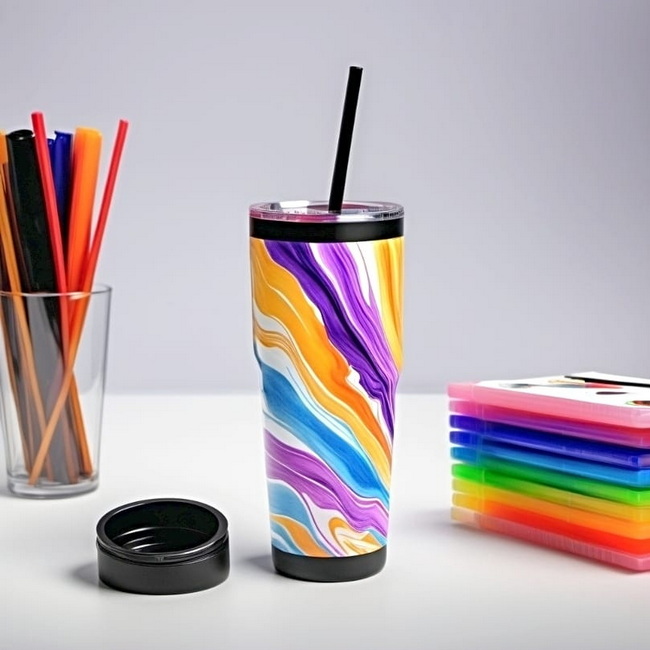
Most stainless steel sublimation tumblers with a polyester-based coating respond well to a narrow range of time and temperature. The following values are effective starting points for consistent, high-quality transfers.
For a heat press, 360-365°F (182-185°C) for about 40 seconds per position with firm, even pressure is a common benchmark. For a convection or sublimation oven, 375°F (190°C) for 5-6 minutes usually produces vibrant results.
To fine-tune settings for a particular setup, adjustments are best made in small increments of around 5°F and 15-30 seconds. Maintaining a detailed record of each test helps quickly identify the optimal combination for each tumbler style.
A reliable sublimation workflow depends on using suitable materials and tools that work together consistently. A complete setup reduces waste, improves output quality, and simplifies troubleshooting.
Key items typically include:
- Sublimation-ready tumblers made of stainless steel or polymer with a dedicated sublimation coating.
- A tumbler heat press or sublimation oven capable of maintaining stable temperatures in the recommended ranges.
- A sublimation printer with compatible sublimation inks and transfer paper.
- Heat-resistant tape to keep transfers firmly in place during heating.
- Heat-resistant gloves for safe handling of hot tumblers.
- Plastic gloves and lint-free cloths to keep tumbler surfaces clean before pressing.
- Adequate ventilation or extraction to manage fumes generated during sublimation.
Consistent sublimation quality requires more than correct time and temperature; small process details significantly affect outcomes. Incorporating a few expert habits leads to more predictable, repeatable results.
Always allow presses and ovens to fully preheat and stabilize before starting production. Apply even pressure across the entire printable area, because weak or uneven pressure often causes dull patches or ghosting.
Avoid touching the coated surface with bare hands to prevent oils from interfering with ink transfer. Use reputable sublimation inks and papers known for strong color reproduction and sharp detail.
Even with recommended settings, defects can occur when time, temperature, pressure, or wrapping are not fully optimized. Recognizing visual symptoms and matching them to likely causes is the fastest way to correct issues.
Faded or washed-out colors usually indicate insufficient time, low temperature, weak pressure, or poor contact between paper and tumbler. Increasing time or temperature slightly and ensuring a tighter wrap typically improves vibrancy.
Brown, yellow, or burnt edges often stem from excessive time or temperature, or from paper extending beyond the coated area. Reducing dwell time, lowering temperature, and trimming paper closer to the design help prevent this.
Ghosting or shadow images usually mean the transfer shifted during heating or removal. More heat-resistant tape, a tighter wrap, and avoiding movement while the tumbler is extremely hot are effective countermeasures.
Uneven color or banding may be caused by cold spots in an oven or inconsistent pressure in a press. Rotating tumblers halfway in the oven or adjusting press alignment and pressure can restore uniform color.
Because equipment, environment, and tumbler coatings vary, maintaining a simple log of test results is one of the most valuable habits in a sublimation workflow. A structured record reduces waste and simplifies scaling to larger runs.
Typical log entries should capture tumbler size, shape, and brand, along with the oven or press model and the tumbler orientation. Recording time, temperature, pressure level, and a brief assessment of print quality allows quick comparison between test runs.
Over time, this log becomes a personalized settings library that makes it easy to reproduce successful results for each tumbler type.
Sublimation equipment reaches high temperatures and produces fumes, so basic safety practices are essential. Attention to safety not only protects users but also keeps studios compliant with local regulations.
Any oven used for sublimation should be permanently dedicated to that purpose and never reused for food preparation. Work in a well-ventilated area, and keep flammable materials away from hot surfaces and heating elements.
Heat-resistant gloves should always be used when handling hot tumblers, and cords, plugs, and heating elements should be checked regularly for wear or damage.
Turning knowledge into consistent output requires a clear, repeatable process that can be followed and refined. A structured approach also makes it easier to train team members and maintain quality as order volumes increase.
Start by choosing the primary method that fits the current workflow, either a convection oven for batch runs or a heat press for fast single-item jobs. Use the recommended baseline settings as a first test and then adjust time or temperature in small increments based on visible results.
Once a reliable combination is identified, standardize wrapping techniques, pressure settings, and cooling routines, and document these steps alongside your preferred parameters.
To move from experimentation to dependable, high-quality production, put these guidelines into practice on the very next batch of tumblers. Choose your primary heating method, apply the recommended starting settings, and begin building a simple log of your test results so you can refine time, temperature, and pressure with confidence. By committing to a consistent process and continuous improvement, you create a stable foundation for scaling your tumbler sublimation projects and delivering professional-level results on every order.
A commonly recommended starting point for coated stainless steel tumblers is 360-365°F (182-185°C) for about 40 seconds per press position with firm, even pressure. The tumbler is rotated and pressed again until the entire wrap has been covered.
Many sublimation tumblers perform well at 375°F (190°C) for 5-6 minutes in a convection or sublimation oven. When the tumbler is placed horizontally, rotating at the halfway mark helps maintain even color and coverage.
Dull or faded prints often indicate insufficient time, low temperature, weak pressure, or poor contact between the transfer paper and the tumbler surface. Slightly increasing time or temperature and ensuring a tighter, well-taped wrap usually improves vibrancy.
An oven used for sublimation should not be used for food again, because sublimation generates fumes that are not intended for food contact. A separate, dedicated oven is strongly recommended for safety.
Different coatings, wall thicknesses, and shapes can require small adjustments to time and temperature, so settings are not universally identical across brands. Testing each new tumbler type and recording successful parameters is the best way to ensure consistent results.


